Algorithms: Quick Notes#
Bitmasks#
Bitmasking performs operations at the bit level (often faster and memory-efficient).
-
Commonly used for:
- subset representation (set of small integers),
- DP over subsets,
- toggling flags,
- fast membership checks.
-
Quick patterns
- Iterate set bits:
while s: lsb = s & -s; ...; s -= lsb - Count bits: Python:
s.bit_count() - Enumerate all subsets of a mask:
sub = mask; while sub: ...; sub = (sub - 1) & mask(also include0separately)
- Iterate set bits:
Convention:
kis 0-indexed from LSB (least-significant bit).
| Operation | Expression | Notes |
|---|---|---|
| Test kth bit | s & (1 << k) |
non-zero means set |
| Turn on kth bit | s = (1 << k) |
(common bug: don’t assign s = (1<<k)) |
| Turn off kth bit | s &= ~(1 << k) |
clears bit |
| Toggle kth bit | s ^= (1 << k) |
flips bit |
| Multiply by 2^n | s << n |
beware overflow in fixed-width languages |
| Divide by 2^n | s >> n |
signed right shift is arithmetic in many languages |
| Intersection | s & t |
set intersection |
| Union | s | t |
set union |
| Set subtraction | s & ~t |
elements in s not in t |
| Extract lowest set bit | s & (-s) |
works with two’s complement |
| Clear lowest set bit | s &= (s - 1) |
removes one lowest-set bit |
| Is power of two | s > 0 and (s & (s - 1)) == 0 |
|
| XOR swap (not recommended) | x ^= y; y ^= x; x ^= y; |
use temp var for clarity |
Sorting#
Complexity summary#
| Algorithm | Best | Average | Worst | Space | Stable |
|---|---|---|---|---|---|
| Quicksort | Ω(n log n) |
Θ(n log n) |
O(n^2) |
O(log n) |
No |
| Mergesort | Ω(n log n) |
Θ(n log n) |
O(n log n) |
O(n) |
Yes |
| Timsort (Python/Java) | Ω(n) |
Θ(n log n) |
O(n log n) |
O(n) |
Yes |
| Heapsort | Ω(n log n) |
Θ(n log n) |
O(n log n) |
O(1) |
No |
| Bubble sort | Ω(n) |
Θ(n^2) |
O(n^2) |
O(1) |
Yes |
| Insertion sort | Ω(n) |
Θ(n^2) |
O(n^2) |
O(1) |
Yes |
| Selection sort | Ω(n^2) |
Θ(n^2) |
O(n^2) |
O(1) |
No |
| Counting sort | Ω(n+k) |
Θ(n+k) |
O(n+k) |
O(k) |
Yes |
| Radix sort | Ω(n·d) |
Θ(n·d) |
O(n·d) |
O(n+k) |
Yes (typical LSD) |
| Bucket sort | Ω(n+k) |
Θ(n+k) |
O(n^2) |
O(n+k) |
depends |
k= value range (counting/bucket),d= number of digits/passes (radix).
Quicksort#
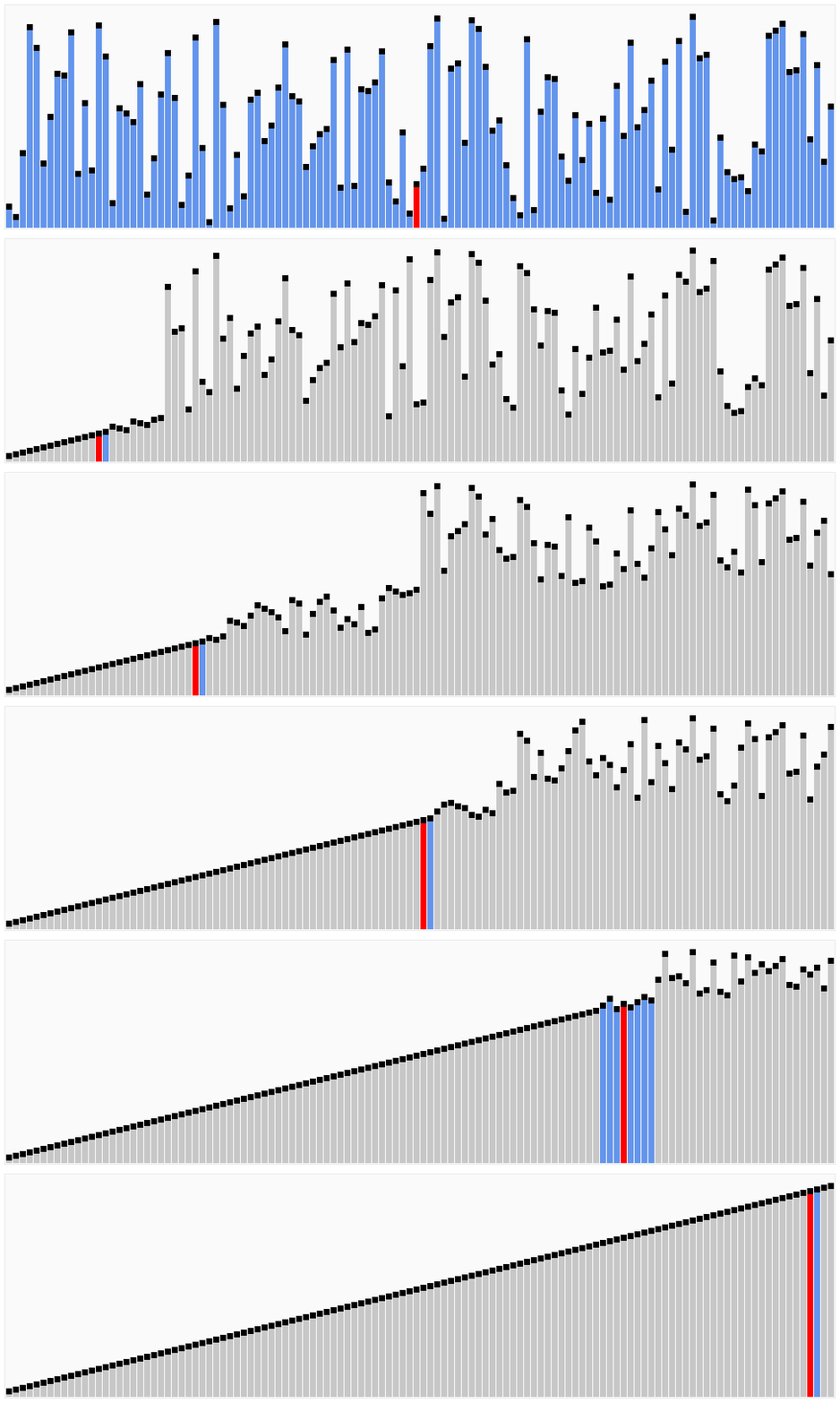
- Partition around pivot; recursively sort left/right.
- Average fast in practice; cache-friendly.
- Worst-case
O(n^2)if pivots are bad (fix: random pivot / median-of-three). - Stable: No
Mergesort#
- Divide array, sort halves, merge.
- Predictable
O(n log n)worst-case; stable. - Needs extra memory
O(n). - Great for linked lists and external sorting (disk).
Timsort#
- Hybrid of mergesort + insertion sort on “runs”.
- Excellent for partially sorted data.
- Used by Python (
sorted,.sort) and Java (objects).
Heapsort#
- Build heap
O(n), then extract max/minntimes. - In-place
O(1)auxiliary space. - Not stable; typically slower than quicksort in practice.
Counting / Radix / Bucket (when to use)#
- Counting sort: integers in small range
[0..k). Fast and stable. - Radix sort: fixed-length integers/strings; uses stable counting per digit.
- Bucket sort: when values are uniformly distributed; choose buckets well.
Permutations#
- Definition: order matters.
- Count (distinct items):
n! - Count (choose
rfromn, order matters):nPr = n! / (n-r)! - Typical interview use:
- generate all permutations (
O(n!)), - permutations with duplicates (needs sorting + skip duplicates),
- next permutation (greedy + reverse suffix).
- generate all permutations (
 1from collections import Counter
 2
 3
 4def permutations(nums):
 5    """All permutations of distinct items. O(n!)."""
 6    res = []
 7    used = [False] * len(nums)
 8    path = []
 9
10    def dfs():
11        if len(path) == len(nums):
12            res.append(path.copy())
13            return
14        for i in range(len(nums)):
15            if used[i]:
16                continue
17            used[i] = True
18            path.append(nums[i])
19            dfs()
20            path.pop()
21            used[i] = False
22
23    dfs()
24    return res
25
26
27def unique_permutations(nums):
28    """Permutations with duplicates handled. O(n!) worst-case, prunes duplicates."""
29    res = []
30    counter = Counter(nums)
31    path = []
32    n = len(nums)
33
34    def dfs():
35        if len(path) == n:
36            res.append(path.copy())
37            return
38        for x in list(counter.keys()):
39            if counter[x] == 0:
40                continue
41            counter[x] -= 1
42            path.append(x)
43            dfs()
44            path.pop()
45            counter[x] += 1
46
47    dfs()
48 return resCombinations#
- Definition: order does not matter.
- Count:
nCr = n! / (r!(n-r)!) - Typical interview use:
- generate
k-combinations via backtracking, - subset generation,
- “choose/not choose” DP patterns.
- generate
 1def combinations(nums, k):
 2    """All k-combinations (order doesn't matter)."""
 3    res = []
 4    path = []
 5
 6    def dfs(i):
 7        if len(path) == k:
 8            res.append(path.copy())
 9            return
10        if i == len(nums):
11            return
12
13        # choose
14        path.append(nums[i])
15        dfs(i + 1)
16        path.pop()
17
18        # skip
19        dfs(i + 1)
20
21    dfs(0)
22    return res
23
24
25def combinations_1_to_n(n, k):
26    """Classic: choose k numbers from 1..n (pruning)."""
27    res = []
28    path = []
29
30    def dfs(start):
31        if len(path) == k:
32            res.append(path.copy())
33            return
34        # pruning: need (k-len(path)) more numbers
35        for x in range(start, n + 1):
36            if (n - x + 1) < (k - len(path)):
37                break
38            path.append(x)
39            dfs(x + 1)
40            path.pop()
41
42    dfs(1)
43    return res
Tree Algorithms#
-
Views of a Tree: Given a binary tree, “views” are what you see from a side/top/bottom.
- Left view: first node at each depth (BFS level-order, pick first).
- Right view: last node at each depth (BFS level-order, pick last).
- Top view: first node encountered for each horizontal distance (HD).
- Bottom view: last node encountered for each horizontal distance (HD).
-
Common implementation:
- BFS with a queue storing
(node, depth, hd). - Use maps:
- left/right:
depth -> value - top/bottom:
hd -> value
- left/right:
- BFS with a queue storing
 1from collections import defaultdict
 2from collections import deque
 3
 4
 5class Node:
 6    def __init__(self, val, left=None, right=None):
 7        self.val = val
 8        self.left = left
 9        self.right = right
10
11
12def left_view(root):
13    if not root: return []
14    q = deque([(root, 0)])
15    first = {}
16    while q:
17        node, depth = q.popleft()
18        if depth not in first:
19            first[depth] = node.val
20        if node.left: q.append((node.left, depth + 1))
21        if node.right: q.append((node.right, depth + 1))
22    return [first[d] for d in sorted(first)]
23
24
25def right_view(root):
26    if not root: return []
27    q = deque([(root, 0)])
28    last = {}
29    while q:
30        node, depth = q.popleft()
31        last[depth] = node.val
32        if node.left: q.append((node.left, depth + 1))
33        if node.right: q.append((node.right, depth + 1))
34    return [last[d] for d in sorted(last)]
35
36
37def top_view(root):
38    """First node encountered at each horizontal distance (hd)."""
39    if not root: return []
40    q = deque([(root, 0)])  # node, hd
41    seen = {}
42    while q:
43        node, hd = q.popleft()
44        if hd not in seen:
45            seen[hd] = node.val
46        if node.left: q.append((node.left, hd - 1))
47        if node.right: q.append((node.right, hd + 1))
48    return [seen[h] for h in sorted(seen)]
49
50
51def bottom_view(root):
52    """Last node encountered at each horizontal distance (hd)."""
53    if not root: return []
54    q = deque([(root, 0)])
55    seen = {}
56    while q:
57        node, hd = q.popleft()
58        seen[hd] = node.val
59        if node.left: q.append((node.left, hd - 1))
60        if node.right: q.append((node.right, hd + 1))
61    return [seen[h] for h in sorted(seen)]
Dynamic Programming#
-
Longest Common Subsequence
- Problem: given strings
A,B, find the longest sequence appearing in both in order (not necessarily contiguous). - Classic DP:
dp[i][j]= LCS length ofA[:i]andB[:j]- Transition:
- if
A[i-1] == B[j-1]:dp[i][j] = 1 + dp[i-1][j-1] - else:
dp[i][j] = max(dp[i-1][j], dp[i][j-1])
- if
- Time:
O(n*m), Space:O(n*m)(orO(min(n,m))for length only)
- Problem: given strings
 1def lcs_length(a: str, b: str) -> int:
 2    """Length only, O(n*m) time, O(min(n,m)) space."""
 3    if len(a) < len(b):
 4        a, b = b, a  # make b shorter for less memory
 5    prev = [0] * (len(b) + 1)
 6    for i in range(1, len(a) + 1):
 7        cur = [0] * (len(b) + 1)
 8        for j in range(1, len(b) + 1):
 9            if a[i - 1] == b[j - 1]:
10                cur[j] = 1 + prev[j - 1]
11            else:
12                cur[j] = max(prev[j], cur[j - 1])
13        prev = cur
14    return prev[-1]
15
16
17def lcs_string(a: str, b: str) -> str:
18    """Reconstruct one LCS, O(n*m) time and space."""
19    n, m = len(a), len(b)
20    dp = [[0] * (m + 1) for _ in range(n + 1)]
21
22    for i in range(1, n + 1):
23        for j in range(1, m + 1):
24            if a[i - 1] == b[j - 1]:
25                dp[i][j] = 1 + dp[i - 1][j - 1]
26            else:
27                dp[i][j] = max(dp[i - 1][j], dp[i][j - 1])
28
29    # backtrack
30    i, j = n, m
31    out = []
32    while i > 0 and j > 0:
33        if a[i - 1] == b[j - 1]:
34            out.append(a[i - 1])
35            i -= 1
36            j -= 1
37        elif dp[i - 1][j] >= dp[i][j - 1]:
38            i -= 1
39        else:
40            j -= 1
41
42    return "".join(reversed(out))
Graph Algorithms#
Traversal: Depth First Search#
- Explore as far as possible before backtracking.
- Uses: connected components, cycle detection, topological sort, bridges/articulation points.
- Time:
O(|V| + |E|)

Traversal: Breadth First Search#
- Level-by-level exploration.
- Uses: shortest paths in unweighted graphs, bipartite check.
- Time:
O(|V| + |E|)

Topological Sort#
- Linear ordering such that for every edge
u -> v,ucomes beforev. - Two common methods:
- Kahn’s algorithm (in-degree + queue)
- DFS finishing times (reverse postorder)
- Time:
O(|V| + |E|) - If you cannot process all nodes (Kahn) ⇒ graph has a cycle.
Shortest path: Dijkstra#
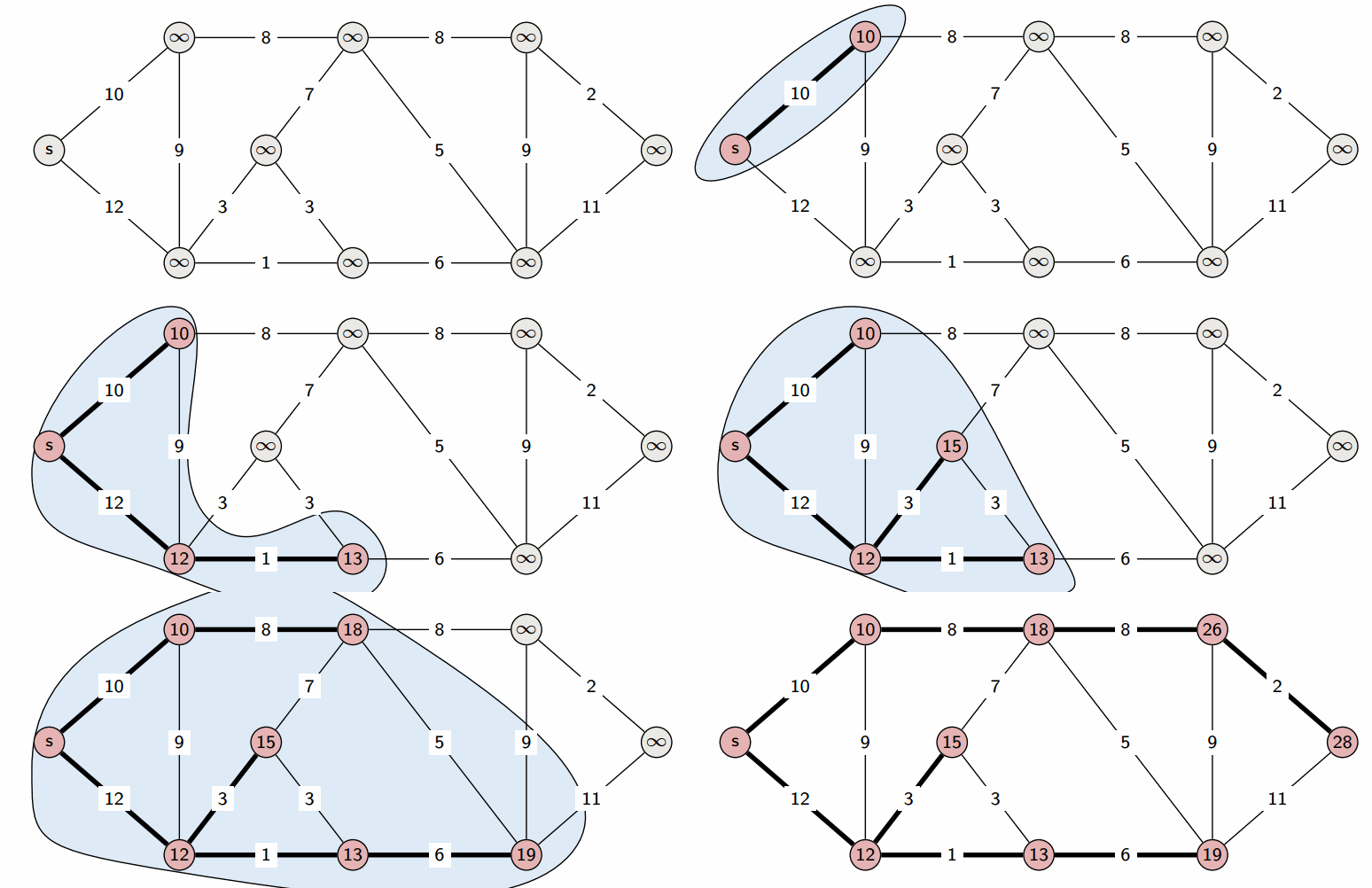
- Single-source shortest paths with non-negative edge weights.
- Typical implementation: adjacency list + min-heap (priority queue).
- Complexity:
- With heap:
O((V+E) log V)(typical) - With array:
O(V^2)(dense graphs)
- With heap:
- Pitfalls:
- Do not use with negative weights.
- Use “lazy deletion” in heap: ignore outdated
(dist, node)pairs.
 1import heapq
 2
 3
 4def dijkstra(n, edges, src):
 5    """
 6    n: number of nodes labeled [0..n-1]
 7    edges: adjacency list {u: [(v, w), ...]}
 8    weights must be non-negative
 9    Returns: dist list
10    """
11    INF = 10**18
12    dist = [INF] * n
13    dist[src] = 0
14    pq = [(0, src)]  # (dist, node)
15
16    while pq:
17        d, u = heapq.heappop(pq)
18        if d != dist[u]:
19            continue  # outdated entry
20        for v, w in edges.get(u, []):
21            nd = d + w
22            if nd < dist[v]:
23                dist[v] = nd
24                heapq.heappush(pq, (nd, v))
25
26    return dist
Shortest path: Bellman–Ford#
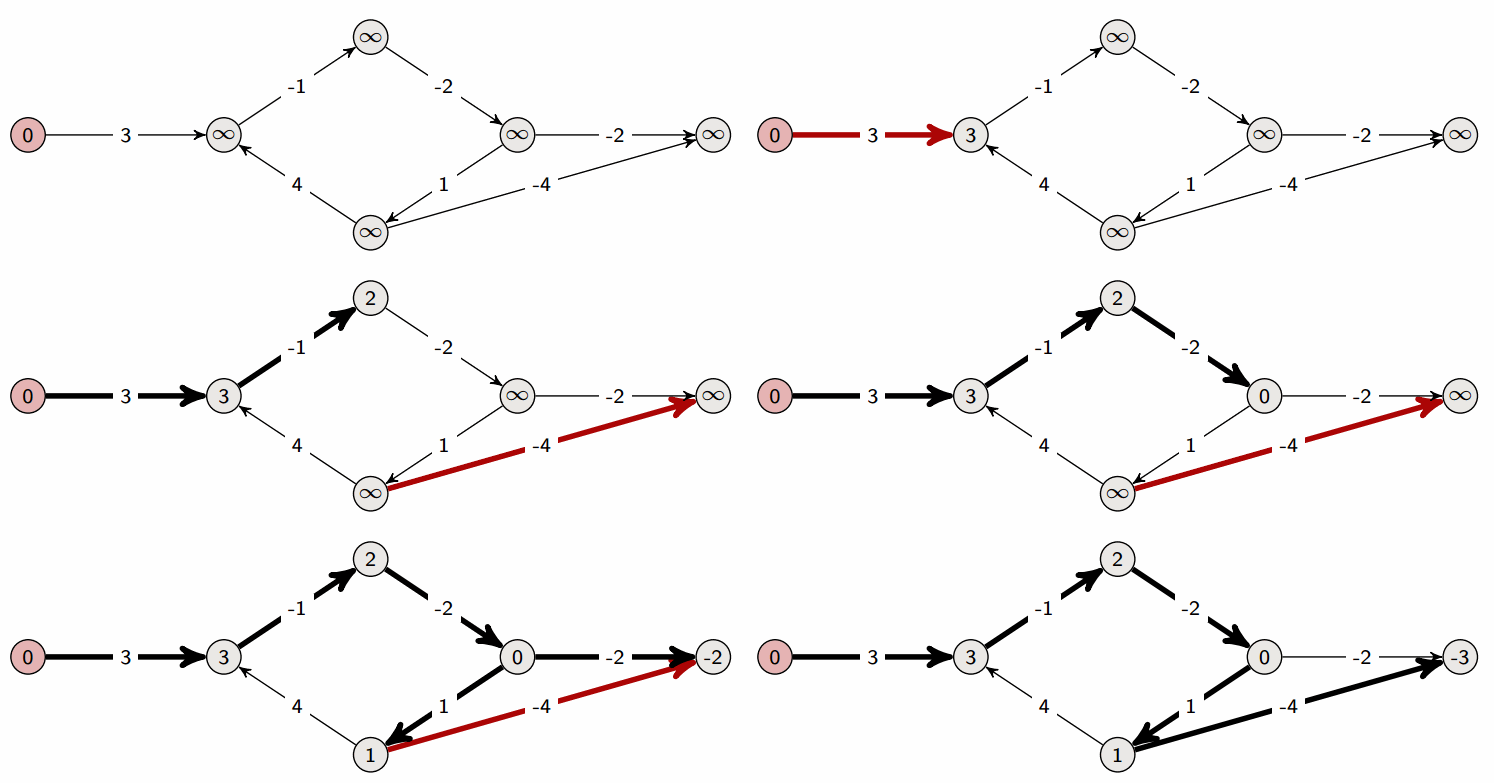
- Handles negative weights; detects negative cycles.
- Time:
O(|V||E|) - If you can relax on V-th iteration ⇒ negative cycle reachable from source.
Shortest path: Floyd–Warshall#
- All-pairs shortest paths.
- DP over intermediate nodes.
- Time:
O(|V|^3), Space:O(|V|^2) - Also used for transitive closure.
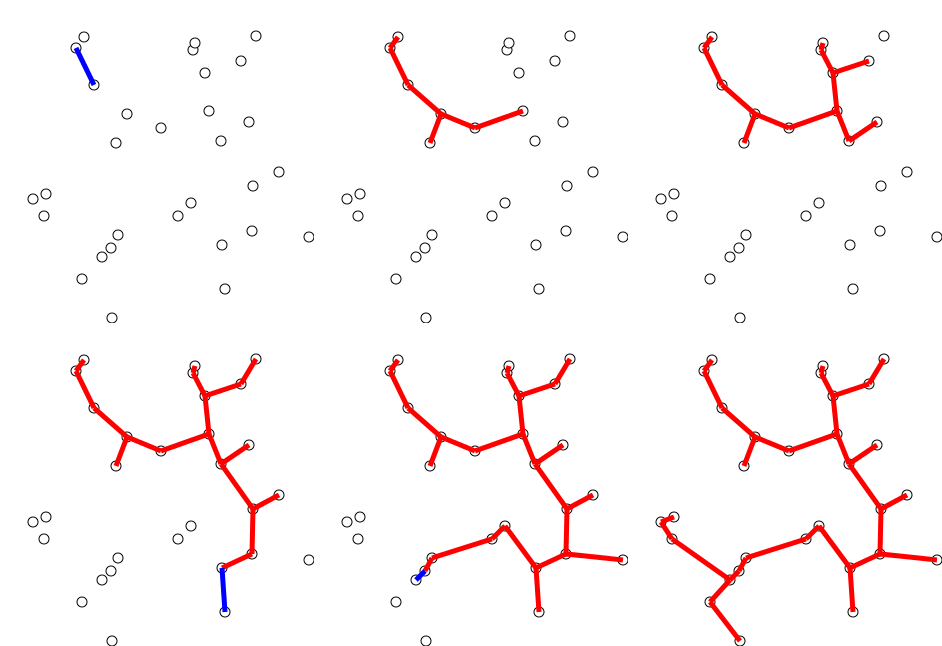
Minimum Spanning Tree (MST): Prim#
- Greedy MST for connected, undirected weighted graph.
- “Grow” a tree by always adding cheapest outgoing edge.
- Time:
O(E log V)with heap.
  1# A Python program for Prims's MST for
  2# adjacency list representation of graph
  3# Source GeeksForGeeks
  4
  5from collections import defaultdict
  6import sys
  7
  8
  9class Heap():
 10    def __init__(self):
 11        self.array = []
 12        self.size = 0
 13        self.pos = []
 14
 15    def newMinHeapNode(self, v, dist):
 16        minHeapNode = [v, dist]
 17        return minHeapNode
 18
 19    # A utility function to swap two nodes of
 20    # min heap. Needed for min heapify
 21    def swapMinHeapNode(self, a, b):
 22        t = self.array[a]
 23        self.array[a] = self.array[b]
 24        self.array[b] = t
 25
 26    # A standard function to heapify at given idx
 27    # This function also updates position of nodes
 28    # when they are swapped. Position is needed
 29    # for decreaseKey()
 30    def minHeapify(self, idx):
 31        smallest = idx
 32        left = 2 * idx + 1
 33        right = 2 * idx + 2
 34
 35        if left < self.size and self.array[left][1] < self.array[smallest][1]:
 36            smallest = left
 37
 38        if right < self.size and self.array[right][1] < self.array[smallest][1]:
 39            smallest = right
 40
 41        # The nodes to be swapped in min heap
 42        # if idx is not smallest
 43        if smallest != idx:
 44
 45            # Swap positions
 46            self.pos[self.array[smallest][0]] = idx
 47            self.pos[self.array[idx][0]] = smallest
 48
 49            # Swap nodes
 50            self.swapMinHeapNode(smallest, idx)
 51
 52            self.minHeapify(smallest)
 53
 54    # Standard function to extract minimum node from heap
 55    def extractMin(self):
 56
 57        # Return NULL wif heap is empty
 58        if self.isEmpty() == True:
 59            return
 60
 61        # Store the root node
 62        root = self.array[0]
 63
 64        # Replace root node with last node
 65        lastNode = self.array[self.size - 1]
 66        self.array[0] = lastNode
 67
 68        # Update position of last node
 69        self.pos[lastNode[0]] = 0
 70        self.pos[root[0]] = self.size - 1
 71
 72        # Reduce heap size and heapify root
 73        self.size -= 1
 74        self.minHeapify(0)
 75
 76        return root
 77
 78    def isEmpty(self):
 79        return True if self.size == 0 else False
 80
 81    def decreaseKey(self, v, dist):
 82
 83        # Get the index of v in heap array
 84
 85        i = self.pos[v]
 86
 87        # Get the node and update its dist value
 88        self.array[i][1] = dist
 89
 90        # Travel up while the complete tree is not
 91        # hepified. This is a O(Logn) loop
 92        while i > 0 and self.array[i][1] < self.array[(i - 1) / 2][1]:
 93
 94            # Swap this node with its parent
 95            self.pos[self.array[i][0]] = (i - 1) / 2
 96            self.pos[self.array[(i - 1) / 2][0]] = i
 97            self.swapMinHeapNode(i, (i - 1) / 2)
 98
 99            # move to parent index
100            i = (i - 1) / 2
101
102    # A utility function to check if a given vertex
103    # 'v' is in min heap or not
104    def isInMinHeap(self, v):
105
106        if self.pos[v] < self.size:
107            return True
108        return False
109
110
111def printArr(parent, n):
112    for i in range(1, n):
113        print("% d - % d" % (parent[i], i))
114
115
116class Graph():
117    def __init__(self, V):
118        self.V = V
119        self.graph = defaultdict(list)
120
121    # Adds an edge to an undirected graph
122    def addEdge(self, src, dest, weight):
123
124        # Add an edge from src to dest. A new node is
125        # added to the adjacency list of src. The node
126        # is added at the begining. The first element of
127        # the node has the destination and the second
128        # elements has the weight
129        newNode = [dest, weight]
130        self.graph[src].insert(0, newNode)
131
132        # Since graph is undirected, add an edge from
133        # dest to src also
134        newNode = [src, weight]
135        self.graph[dest].insert(0, newNode)
136
137    # The main function that prints the Minimum
138    # Spanning Tree(MST) using the Prim's Algorithm.
139    # It is a O(ELogV) function
140    def PrimMST(self):
141        # Get the number of vertices in graph
142        V = self.V
143
144        # key values used to pick minimum weight edge in cut
145        key = []
146
147        # List to store contructed MST
148        parent = []
149
150        # minHeap represents set E
151        minHeap = Heap()
152
153        # Initialize min heap with all vertices. Key values of all
154        # vertices (except the 0th vertex) is is initially infinite
155        for v in range(V):
156            parent.append(-1)
157            key.append(sys.maxsize)
158            minHeap.array.append(minHeap.newMinHeapNode(v, key[v]))
159            minHeap.pos.append(v)
160
161        # Make key value of 0th vertex as 0 so
162        # that it is extracted first
163        minHeap.pos[0] = 0
164        key[0] = 0
165        minHeap.decreaseKey(0, key[0])
166
167        # Initially size of min heap is equal to V
168        minHeap.size = V
169
170        # In the following loop, min heap contains all nodes
171        # not yet added in the MST.
172        while minHeap.isEmpty() == False:
173
174            # Extract the vertex with minimum distance value
175            newHeapNode = minHeap.extractMin()
176            u = newHeapNode[0]
177
178            # Traverse through all adjacent vertices of u
179            # (the extracted vertex) and update their
180            # distance values
181            for pCrawl in self.graph[u]:
182
183                v = pCrawl[0]
184
185                # If shortest distance to v is not finalized
186                # yet, and distance to v through u is less than
187                # its previously calculated distance
188                if minHeap.isInMinHeap(v) and pCrawl[1] < key[v]:
189                    key[v] = pCrawl[1]
190                    parent[v] = u
191
192                    # update distance value in min heap also
193                    minHeap.decreaseKey(v, key[v])
194
195        printArr(parent, V)
196
197
198# Driver program to test the above functions
199graph = Graph(9)
200graph.addEdge(0, 1, 4)
201graph.addEdge(0, 7, 8)
202graph.addEdge(1, 2, 8)
203graph.addEdge(1, 7, 11)
204graph.addEdge(2, 3, 7)
205graph.addEdge(2, 8, 2)
206graph.addEdge(2, 5, 4)
207graph.addEdge(3, 4, 9)
208graph.addEdge(3, 5, 14)
209graph.addEdge(4, 5, 10)
210graph.addEdge(5, 6, 2)
211graph.addEdge(6, 7, 1)
212graph.addEdge(6, 8, 6)
213graph.addEdge(7, 8, 7)
214graph.PrimMST()
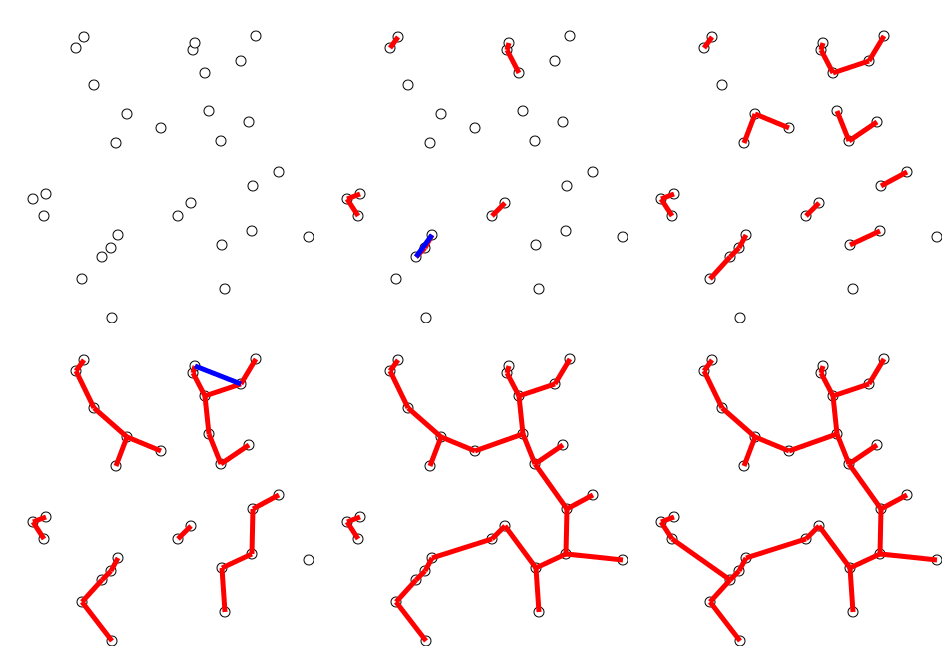
Minimum Spanning Tree (MST): Kruskal#
- Sort edges by weight; add if it doesn’t form a cycle (DSU/Union-Find).
- Time:
O(E log E)(sorting dominates).
 1# Python program for Kruskal's algorithm to find
 2# Minimum Spanning Tree of a given connected,
 3# undirected and weighted graph. Source: GeeksForGeeks.
 4
 5
 6#Class to represent a graph
 7class Graph:
 8    def __init__(self, vertices):
 9        self.V = vertices  #No. of vertices
10        self.graph = []
11
12    # function to add an edge to graph
13    def addEdge(self, u, v, w):
14        self.graph.append([u, v, w])
15
16    # A utility function to find set of an element i
17    # (uses path compression technique)
18    def find(self, parent, i):
19        if parent[i] == i:
20            return i
21        return self.find(parent, parent[i])
22
23    # A function that does union of two sets of x and y
24    # (uses union by rank)
25    def union(self, parent, rank, x, y):
26        xroot = self.find(parent, x)
27        yroot = self.find(parent, y)
28
29        # Attach smaller rank tree under root of
30        # high rank tree (Union by Rank)
31        if rank[xroot] < rank[yroot]:
32            parent[xroot] = yroot
33        elif rank[xroot] > rank[yroot]:
34            parent[yroot] = xroot
35
36        # If ranks are same, then make one as root
37        # and increment its rank by one
38        else:
39            parent[yroot] = xroot
40            rank[xroot] += 1
41
42    # The main function to construct MST using Kruskal's
43    # algorithm
44    def KruskalMST(self):
45
46        result = []  #This will store the resultant MST
47
48        i = 0  # An index variable, used for sorted edges
49        e = 0  # An index variable, used for result[]
50
51        # Step 1: Sort all the edges in non-decreasing
52        # order of their
53        # weight. If we are not allowed to change the
54        # given graph, we can create a copy of graph
55        self.graph = sorted(self.graph, key=lambda item: item[2])
56
57        parent = []
58        rank = []
59
60        # Create V subsets with single elements
61        for node in range(self.V):
62            parent.append(node)
63            rank.append(0)
64
65        # Number of edges to be taken is equal to V-1
66        while e < self.V - 1:
67
68            # Step 2: Pick the smallest edge and increment
69            # the index for next iteration
70            u, v, w = self.graph[i]
71            i = i + 1
72            x = self.find(parent, u)
73            y = self.find(parent, v)
74
75            # If including this edge does't cause cycle,
76            # include it in result and increment the index
77            # of result for next edge
78            if x != y:
79                e = e + 1
80                result.append([u, v, w])
81                self.union(parent, rank, x, y)
82            # Else discard the edge
83
84        # print the contents of result[] to display the built MST
85        print("Following are the edges in the constructed MST")
86        for u, v, weight in result:
87            #print str(u) + " -- " + str(v) + " == " + str(weight)
88            print("%d -- %d == %d" % (u, v, weight))
89
90
91# Driver code
92g = Graph(4)
93g.addEdge(0, 1, 10)
94g.addEdge(0, 2, 6)
95g.addEdge(0, 3, 5)
96g.addEdge(1, 3, 15)
97g.addEdge(2, 3, 4)
98
99g.KruskalMST()
Greedy Algorithms#
-
Greedy algorithms pick the locally optimal option at each step.
-
Typically applicable when:
- Optimal substructure
- Greedy choice property (local choice can be extended to global optimum)
-
Examples:
- interval scheduling
- Huffman coding
- MST (Prim/Kruskal)
- Dijkstra (greedy choice on next closest node)
Probability: mapping to a larger sample space#
Sometimes you’re given probabilities on a coarse sample space and must expand to a finer one.
-
Key identity:
- If coarse events partition space:
A1, A2, ... - And fine event is
B:P(B) = Σ P(B | Ai) P(Ai)(Law of Total Probability)
- If coarse events partition space:
-
Mapping rule (coarse → refined outcomes):
- For each coarse outcome
Ai, assign probabilities to refined outcomes{rij}such that:P(rij) = P(Ai) * P(rij | Ai)- and
Σ_j P(rij | Ai) = 1
- For each coarse outcome
-
Common interview pattern:
- “Given P(even)=0.6, P(odd)=0.4, and uniform within parity, compute P(roll=2).”
P(2)=P(even)*1/3=0.2
- “Given P(even)=0.6, P(odd)=0.4, and uniform within parity, compute P(roll=2).”
 1def refine_distribution(coarse_probs, conditional_refinement):
 2    """
 3    coarse_probs: dict coarse_outcome -> P(coarse)
 4    conditional_refinement: dict coarse_outcome -> dict refined_outcome -> P(refined | coarse)
 5
 6    Returns refined_probs: dict refined_outcome -> P(refined)
 7
 8    Requires each conditional distribution sums to ~1.
 9    """
10    refined = {}
11    for coarse, p_coarse in coarse_probs.items():
12        cond = conditional_refinement[coarse]
13        for r, p_r_given_c in cond.items():
14            refined[r] = refined.get(r, 0.0) + p_coarse * p_r_given_c
15    return refined
Piecewise functions: Tax slabs#
-
Tax slabs are typically progressive:
- Income is split into brackets, each taxed at its rate.
- Total tax is sum over brackets.
-
Implementation pattern:
- iterate brackets in ascending order,
- taxable amount in bracket =
min(income, upper) - lower(clamped to ≥ 0), - add
taxable * rate.
-
Pitfalls:
- inclusive/exclusive boundaries,
- handling “no upper bound” last slab,
- rounding rules.
 1def tax_progressive(income, slabs):
 2    """
 3    slabs: list of (lower_inclusive, upper_exclusive_or_None, rate)
 4    Example:
 5      slabs = [
 6        (0, 250000, 0.0),
 7        (250000, 500000, 0.05),
 8        (500000, 1000000, 0.20),
 9        (1000000, None, 0.30),
10      ]
11    """
12    tax = 0.0
13    for lo, hi, rate in slabs:
14        if income <= lo:
15            break
16        upper = income if hi is None else min(income, hi)
17        taxable = max(0.0, upper - lo)
18        tax += taxable * rate
19        if hi is not None and income < hi:
20            break
21    return tax
Streams of Data (online algorithms)#
When data arrives continuously and you can’t store everything.
-
Common tasks + standard tools
- Running mean/variance: Welford’s algorithm (
O(1)memory) - Top-k / median:
- top-k: min-heap of size k
- median: two heaps (max-heap left, min-heap right)
- Sliding window max/min: monotonic deque
- Random sampling from unknown-length stream: reservoir sampling
- Membership (approx): Bloom filter
- Frequency (approx): Count-Min Sketch / Misra–Gries (heavy hitters)
- Running mean/variance: Welford’s algorithm (
-
Key concept:
- Choose exact vs approximate depending on memory/latency constraints.
 1import random
 2
 3
 4def reservoir_sample(stream, k, rng=random):
 5    """
 6    Sample k items uniformly from a stream of unknown length.
 7    Returns a list of size min(k, n).
 8    """
 9    reservoir = []
10    for i, x in enumerate(stream, start=1):
11        if i <= k:
12            reservoir.append(x)
13        else:
14            j = rng.randint(1, i)
15            if j <= k:
16                reservoir[j - 1] = x
17 return reservoir 1import math
2
3
4class RunningStats:
5 """Welford's algorithm: online mean/variance in O(1) memory."""
6 def __init__(self):
7 self.n = 0
8 self.mean = 0.0
9 self.M2 = 0.0
10
11 def add(self, x: float):
12 self.n += 1
13 delta = x - self.mean
14 self.mean += delta / self.n
15 delta2 = x - self.mean
16 self.M2 += delta * delta2
17
18 def variance(self):
19 if self.n < 2:
20 return 0.0
21 return self.M2 / (self.n - 1) # sample variance
22
23 def stddev(self):
24 return math.sqrt(self.variance()) 1from collections import deque
2
3
4def sliding_window_max(nums, k):
5 """
6 Monotonic deque: O(n)
7 Returns list of max of each window of size k.
8 """
9 dq = deque() # store indices, values decreasing
10 out = []
11 for i, x in enumerate(nums):
12 while dq and dq[0] <= i - k:
13 dq.popleft()
14 while dq and nums[dq[-1]] <= x:
15 dq.pop()
16 dq.append(i)
17 if i >= k - 1:
18 out.append(nums[dq[0]])
19 return out 1import heapq
2
3
4class RunningMedian:
5 """
6 Two heaps:
7 left: max-heap (store negatives)
8 right: min-heap
9 """
10 def __init__(self):
11 self.left = []
12 self.right = []
13
14 def add(self, x: float):
15 if not self.left or x <= -self.left[0]:
16 heapq.heappush(self.left, -x)
17 else:
18 heapq.heappush(self.right, x)
19
20 # rebalance
21 if len(self.left) > len(self.right) + 1:
22 heapq.heappush(self.right, -heapq.heappop(self.left))
23 elif len(self.right) > len(self.left):
24 heapq.heappush(self.left, -heapq.heappop(self.right))
25
26 def median(self):
27 if not self.left and not self.right:
28 return None
29 if len(self.left) == len(self.right):
30 return (-self.left[0] + self.right[0]) / 2.0
31 return -self.left[0]